
I redesigned USDA's Direct Farm Loan Application — turning a 29-page paper process into a guided digital experience for the 26,000 producers who apply each year.
Why This Work Matters
Access to clear, timely financing is critical for small and family farms. Simplifying the loan process reduces barriers, speeds up funding, and helps stabilize rural businesses and local economies.


01
Farming is cash-flow heavy and time-sensitive
Delays in financing can mean missed planting windows, lost revenue, or higher debt.
03
Paper-heavy processes create real barriers
Long, manual applications are hard for farmers managing operations on their own.
02
Many small and family farms have no backup lender
USDA loans are often the only path to staying in business.
04
Faster, clearer access to credit strengthens rural economies
When farms stay funded, local jobs, suppliers, and small businesses stay stable.
My Role
Senior UX /UI Designer
-
Led end-to-end UX for a federal loan modernization effort\
-
Translated complex policy requirements into scalable product decisions
-
Drove alignment across product, engineering, and stakeholders
The Problem
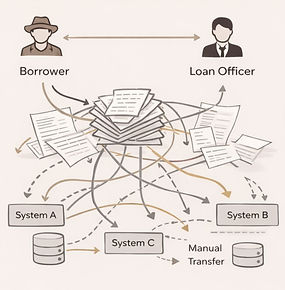
The USDA loan application was a fragmented, paper-based system spanning multiple disconnected tools — creating confusion, delays, and heavy manual work.
-
Complex forms made applications difficult to complete
-
Borrowers lacked clarity on the process and requirements
-
Disconnected systems required redundant data entry
-
Staff manually transferred data between systems
Resulting in slow applications, incomplete submissions, and significant operational friction.
Product Goals
Reduce application complexity
Decrease completion
time
Improve first-time submission completeness
Reduce manual
processing time
Modernize from paper to structured digital workflow
My Approach
I designed a structured, step-based workflow that balanced user needs, federal policy, and system constraints. This meant:
-
Converting long-form content into progressive steps
-
Aligning application logic with underwriting requirements
-
Simplifying content while preserving federal compliance
-
Designing scalable architecture for future borrower types
I led product direction by guiding stakeholders through multiple design approaches, making tradeoffs explicit across:
-
Technical complexity
-
Implementation timeline
-
Policy compliance
-
User experience impact
This enabled the client to make informed decisions grounded in feasibility, compliance, and user outcomes - not just design preference.
Research & Insights
I worked from existing USDA research — including GSA's Direct Farm Loans journey mapping — plus ongoing input from loan officers and product owners.
• Redundant forms with no clear sequence
• Incomplete applications triggering repeated follow-up
• Fillable PDFs disconnected from backend systems, forcing staff to rekey data
• No visibility into status or next steps
• Processing stretched for months under documentation load
I validated direction through demos and review cycles with product owners, iterating as policy and technical constraints surfaced.
Key Design Decisions
These solutions worked together to transform a fragmented, paper-based process into a structured digital experience that reduced friction, improved completion, and increased transparency for both borrowers and loan officers.

Structured Application Workflow
The original loan process relied on a 29-page manual PDF, creating confusion, delays, and incomplete submissions.
I led the UX direction, redesigning the experience into a guided, step-based workflow with clear sections, navigation, and progress tracking.
Impact
-
Reduced application time from 5.5 hours → 90 minutes
-
Improved completion rates by guiding users step-by-step
-
Enabled stakeholders to align on a scalable digital model

Document Upload Within Application
Applicants previously submitted documents separately or after the fact, leading to delays and constant follow-ups from loan officers.
I designed an in-flow document upload system that allows users to submit required materials directly within each step of the application.
Impact
-
Increased submission completeness earlier in the process
-
Reduced manual follow-ups from loan officers
-
Streamlined review workflows across teams

Borrower Dashboard
Borrowers had little visibility into application status and relied on service centers for updates.
I designed a centralized dashboard that surfaces application status, progress, and required actions.
Impact
-
Increased visibility into application progress
-
Reduced support inquiries
-
Enabled users to self-serve and resume applications easily

Loan Payment Calculator
Applicants often started the process without understanding affordability, leading to drop-off or misaligned expectations.
I designed a loan calculator that helps users estimate monthly payments before applying, using real inputs and instant feedback.
Impact
-
Helped users make informed decisions earlier
-
Reduced friction at application start
-
Supported a faster, more confident application flow
Results / Outcomes
Transforming a federal loan system at scale
26,000 applications a year
85,000 direct loan borrowers
20+ legacy systems replaced
900+ offices nationwide

Paper application reduced from 29 pages to 13 pages

Average completion time reduced from 5+ hours to 90 minutes
Design Constraints & Tradeoffs
Modernizing a 29-page paper application required balancing strict federal policy, engineering feasibility, and borrower usability — often with competing priorities.
I worked closely with product and engineering to evaluate design decisions based on:
-
Technical complexity
-
Impact on delivery timeline
-
Policy compliance requirements
-
Borrower and loan officer experience
Rather than optimizing for a single outcome, I made tradeoffs to ensure the solution remained buildable, compliant, and usable.
In several cases, this meant simplifying workflows and adjusting scope to deliver a product that could launch within constraints while still improving the overall experience.
Reflection / What I Learned
Designing a federal lending product required balancing policy compliance, technical constraints, and borrower usability — not as tradeoffs, but as a connected system.
-
Translate policy into product behavior
Regulatory requirements were reframed into clear, step-based workflows users could actually complete
-
Design with constraints, not around them
Early collaboration with engineering and product ensured solutions were feasible and scalable from the start
-
Structure drives usability
Breaking a 29-page process into guided steps significantly improved clarity, completion, and user confidence
